The Problem with Leaving Money Directly to Someone on SSI or Medicaid
Supplemental Security Income (SSI) and Medicaid are needs-based programs. To remain eligible, a recipient generally cannot own more than $2,000 in countable resources. An inheritance — even a modest one — can push a beneficiary over that limit and trigger a loss of benefits until the money is spent down.
This puts parents in an impossible position. Leave nothing and your child is unprovided for. Leave something outright and you may inadvertently cut off the government support that sustains their daily life.
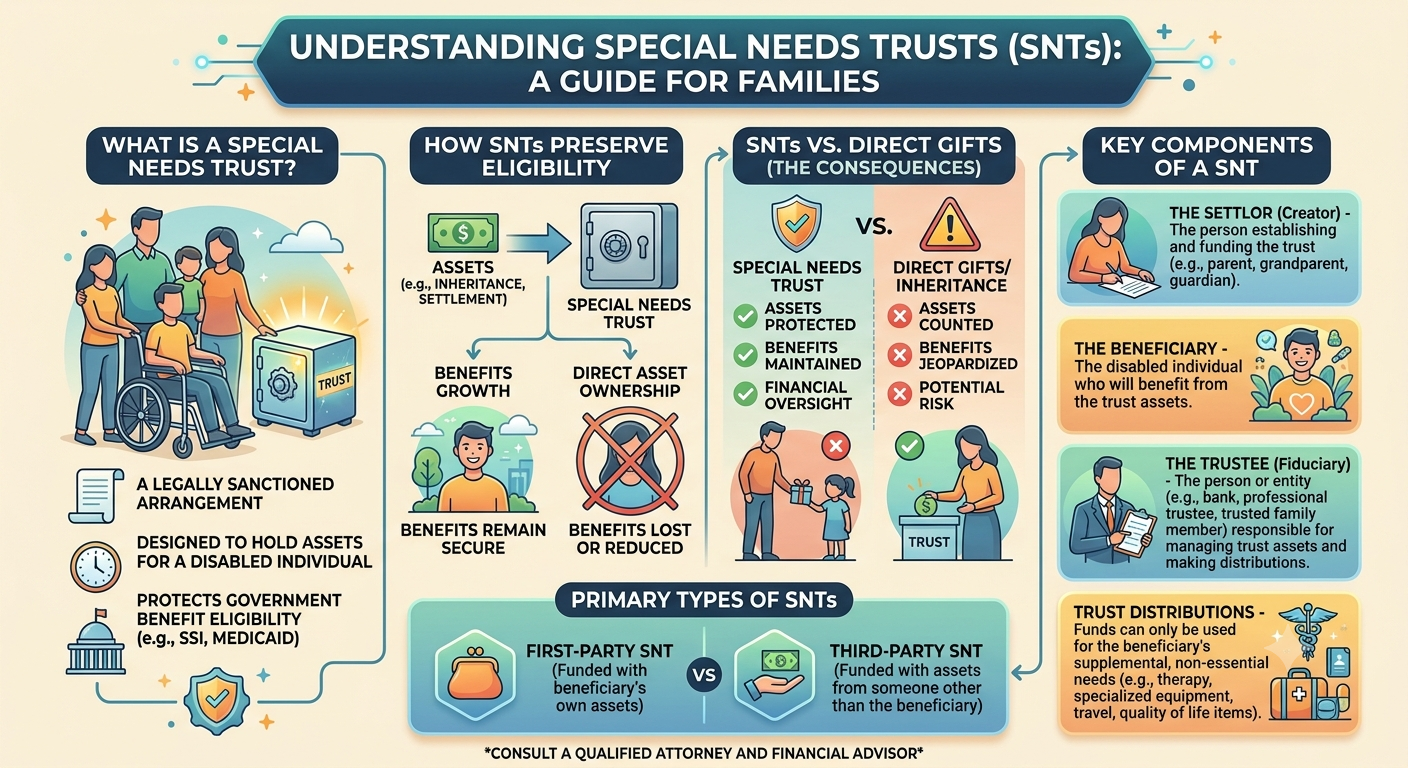
A special needs trust resolves this. When properly drafted, the trust holds the inheritance as a non-countable resource — outside your child's SSI and Medicaid limits — while still making funds available for their supplemental needs.
The core rule: Assets held in a properly drafted special needs trust are not counted as the beneficiary's resources for SSI or Medicaid purposes. The trust supplements government benefits — it does not replace them.
Third-Party Special Needs Trusts
A third-party special needs trust is funded with someone else's assets — a parent's estate, a grandparent's gift, life insurance proceeds, or an inheritance from a sibling. Family members, friends, and others can contribute to one, but the beneficiary cannot fund it with their own assets.
How it works
You create the trust — either as a standalone document during your lifetime or inside your will to take effect at your death — and name your child or loved one as the beneficiary. The trustee holds and manages the funds, making distributions for supplemental needs at their discretion. When the beneficiary dies, whatever remains in the trust passes to the remainder beneficiaries you named — typically your other children or heirs.
The critical feature: no Medicaid payback is required. Because the trust was funded with your money, not the beneficiary's, the government has no claim on the remaining assets at the beneficiary's death.
Standalone vs. testamentary
A standalone third-party SNT is created and funded during your lifetime. This has a significant advantage: it allows others — grandparents, aunts and uncles, family friends — to contribute to the trust while you are all living. They can name the trust as the beneficiary of their own life insurance policies or retirement accounts, directing those assets into the trust at their death rather than leaving them outright to your child.
A testamentary special needs trust is written into your will and funded only when you die. It is simpler to set up, but cannot receive contributions from others during your lifetime, which limits coordination across the whole family.
First-Party Special Needs Trusts
When a person with a disability comes into assets of their own — through a personal injury settlement, an outright inheritance they have already received, or their own savings — a first-party special needs trust (also called a self-settled or (d)(4)(A) trust under federal law) allows those funds to be held in trust without disqualifying the beneficiary from SSI or Medicaid.
Key differences from a third-party trust
First-party trusts carry requirements that third-party trusts do not:
- The beneficiary must be under age 65 when the trust is established — though pooled trusts are an exception and can be used at any age
- The trust must be irrevocable
- At the beneficiary's death, Medicaid must be reimbursed for benefits paid during the beneficiary's lifetime before any remaining assets pass to heirs
Despite the payback requirement, a first-party SNT is often the only way to preserve benefits for a beneficiary who has already received assets. The alternative — spending down to $2,000 before reapplying for benefits — loses the funds entirely. The trust at least preserves what remains after the Medicaid payback.
| Feature | Third-Party SNT | First-Party SNT |
|---|---|---|
| Funded with whose assets? | Parent's, grandparent's, or other family member's | The beneficiary's own assets |
| Common funding sources | Estate inheritance, life insurance, gifts | Personal injury settlement, received inheritance, savings |
| Medicaid payback at death? | No | Yes — Medicaid reimbursed first |
| Age limit to establish | None | Beneficiary must be under 65 (pooled trusts are an exception) |
| Who can fund it? | Family members, friends, and others — not the beneficiary | The beneficiary only (their own assets) |
| Remainder at death | Passes to heirs as directed | Medicaid reimbursed first; remainder to heirs |
What a Special Needs Trust Can Pay For
The trustee has discretion over distributions, and that discretion matters. Distributions that replace basic support provided by SSI — food, shelter — can reduce the beneficiary's monthly SSI payment. Distributions for supplemental needs generally do not.
Common supplemental expenses a special needs trust can cover include:
- Transportation — a vehicle, rideshares, bus passes
- Technology — computers, tablets, communication devices, phone service
- Recreation and travel — hobbies, vacations, event tickets, gym memberships
- Education and vocational training
- Out-of-pocket medical, dental, and vision costs not covered by Medicaid
- Personal care items and clothing beyond what government programs provide
- Furniture and household goods
- Legal fees, advocacy services, and care management
Because SSI rules around in-kind support can be technical, careful trustee guidance — and a well-drafted trust document — helps protect the beneficiary's benefit levels while still giving them a meaningful quality of life.
Choosing a Trustee
The trustee of a special needs trust has an unusual dual responsibility: manage the assets prudently, and make distribution decisions that protect the beneficiary's government benefits without sacrificing their quality of life. That combination calls for careful thought about who should serve.
Family member trustee
A trusted family member — a sibling, aunt, or uncle — often knows the beneficiary best and can make nuanced decisions about their needs. The challenges: they may lack investment experience, they must navigate the SSI distribution rules without inadvertently reducing benefits, and they take on a long-term legal responsibility that can become a burden over decades.
Professional or corporate trustee
A professional trustee or bank trust department brings investment expertise and institutional continuity — they will still be there in thirty years. The tradeoff is that they may not know the beneficiary personally and their fees reduce the trust corpus over time. Some families name a family member as co-trustee alongside a professional institution to combine both strengths.
Pooled special needs trust
A pooled trust is administered by a nonprofit organization. Individual beneficiaries have separate accounts, but assets are pooled for investment purposes, which can make professional management accessible for smaller trust amounts. Pooled trusts also carry the payback requirement for first-party accounts, but third-party pooled accounts typically allow remaining assets to pass to heirs or remain in the pool for other beneficiaries. They are worth considering when the trust corpus is modest or when no suitable individual trustee is available.
Coordinating the Rest of Your Estate Plan
A special needs trust does not stand alone — it has to be woven into the rest of your estate plan to work correctly.
- Your will should direct any inheritance for the beneficiary into the special needs trust rather than outright to them
- Life insurance and retirement accounts can name the trust as beneficiary — keeping those assets out of the beneficiary's hands while still making them available for supplemental support
- Other family members — grandparents, siblings — need to know the trust exists and update their own estate plans to direct gifts through it rather than directly to the beneficiary
- Guardianship may also need to be addressed if the beneficiary lacks the capacity to manage their own affairs; a guardian or conservator is a separate legal role from the trustee
A note on ABLE accounts
ABLE accounts are tax-advantaged savings accounts available to individuals whose disability began before age 26. They allow the account holder to save and spend on qualified disability expenses without affecting SSI or Medicaid eligibility, up to certain limits. An ABLE account and a special needs trust can complement each other — an ABLE account may be more accessible for day-to-day expenses, while the trust holds larger assets for long-term support. A financial advisor can help determine how the two tools fit together for your family.
What I Do for Families with Special Needs
- Draft third-party special needs trusts — standalone or testamentary — tailored to the beneficiary's specific situation and benefit programs
- Draft first-party special needs trusts when a beneficiary has received or will receive their own assets
- Review and update your will, life insurance designations, and retirement account beneficiary designations to direct assets through the trust
- Help you think through the trustee selection and structure a co-trustee arrangement when appropriate
- Coordinate planning so that other family members — grandparents, siblings — can contribute to the trust through their own estate plans
Frequently Asked Questions
-
An outright inheritance will likely disqualify your child from SSI and Medicaid until the funds are spent down. SSI has a $2,000 resource limit for an individual. A properly drafted third-party special needs trust holds the inheritance outside your child's countable resources, preserving their eligibility while still providing supplemental support.
-
A third-party special needs trust is funded with someone else's money — a parent's estate, a grandparent's gift, life insurance proceeds. It does not require a Medicaid payback provision. A first-party special needs trust is funded with the beneficiary's own assets, such as a personal injury settlement or an inheritance they received outright. It does require Medicaid to be repaid from remaining assets at the beneficiary's death.
-
A special needs trust is designed to pay for supplemental needs — things that government benefits do not cover or cover inadequately. This commonly includes transportation, technology and communication devices, recreation and travel, education, personal care items, clothing, furniture, and out-of-pocket medical or dental expenses. The trust should not replace basic support that SSI or Medicaid provides, as improper distributions can reduce or eliminate benefits.
-
There are three main options: a trusted family member who knows the beneficiary well but may lack investment or legal expertise; a professional or corporate trustee with investment experience but less personal knowledge of the beneficiary; or a pooled special needs trust administered by a nonprofit, where assets are pooled for investment but each beneficiary has a separate account. The right choice depends on the size of the trust, whether a qualified family member is available, and the family's long-term planning.
-
A third-party special needs trust can be created during your lifetime (a standalone trust) or set up inside your will to take effect at your death (a testamentary special needs trust). A standalone trust has the advantage of allowing others — grandparents, aunts and uncles — to contribute to it during your lifetime, including through beneficiary designations on life insurance and retirement accounts.