The Problem Blended Families Face
Most estate plans are built around a simple assumption: you leave everything to your spouse, and your spouse leaves everything to your children. In a blended family, that assumption breaks down.
If you leave your estate outright to a surviving spouse, they own it. They can spend it, give it away, or — if they remarry — leave it entirely to a new spouse or stepchildren. By the time they die, nothing may remain for the children you intended to provide for.
On the other hand, leaving everything directly to your children from a prior marriage may leave your surviving spouse without enough support during their lifetime.
The solution is a structure that does both: provides genuine support for your spouse while preserving the principal for your children. That structure is usually built around a QTIP trust.
The core challenge: Outright gifts to a surviving spouse put your children at risk. Leaving your spouse out of your plan creates its own problems. A properly structured trust resolves the conflict — your spouse is provided for during their lifetime, and your children inherit at the spouse's death.
The QTIP Trust: Providing for Your Spouse Without Disinheriting Your Children
A Qualified Terminable Interest Property (QTIP) trust is a marital trust that qualifies for the federal estate tax marital deduction while allowing you to control who ultimately inherits the principal.
How it works
You fund the QTIP trust at your death. Your surviving spouse receives all of the trust's income for the rest of their life — they are provided for. When your spouse dies, the remaining principal passes to the beneficiaries you named when you created the trust, typically your children from a prior marriage.
The key feature: your spouse cannot redirect the principal. They cannot leave it to a new spouse. They cannot give it to their own children from a prior relationship. The ultimate destination of your assets is locked in by the trust you created — not by decisions your spouse makes after you are gone.
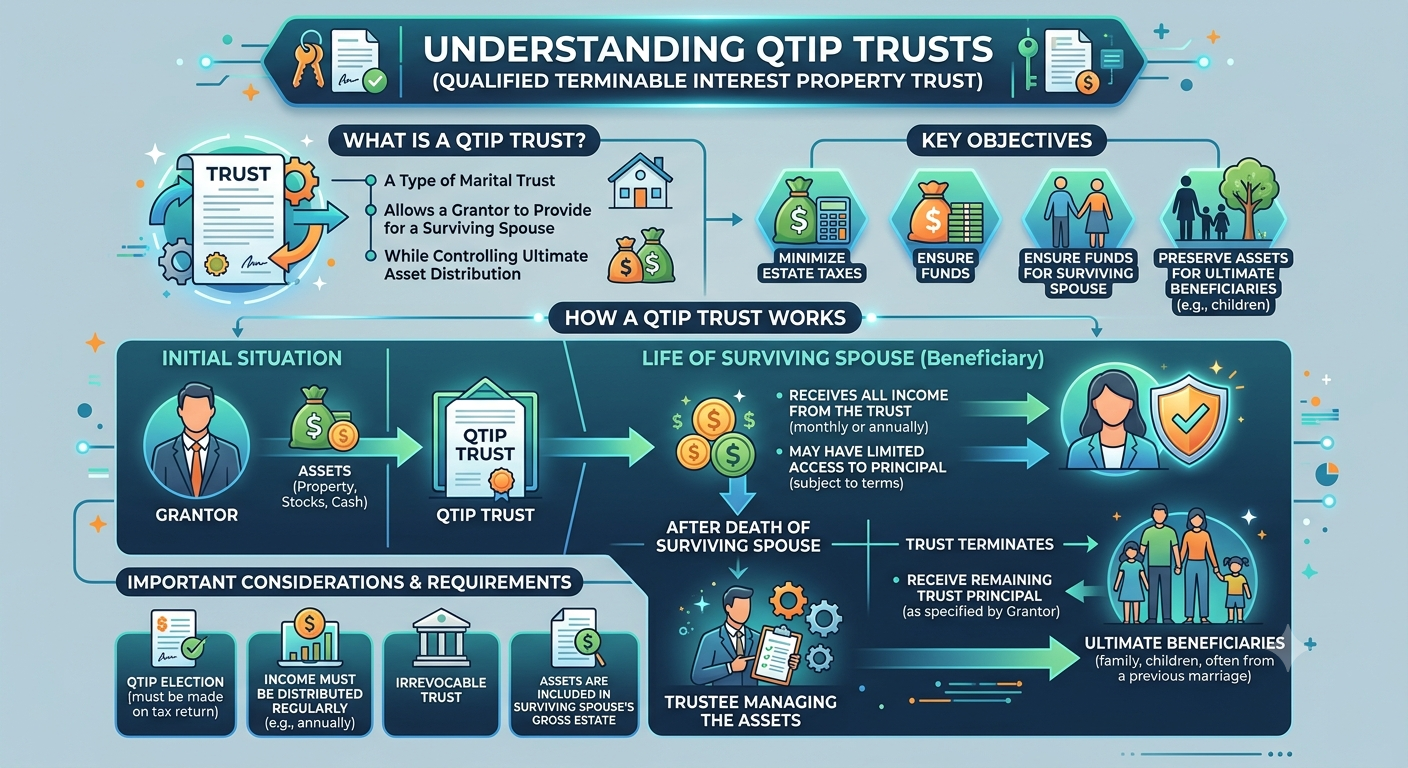
What the trustee controls
A trustee — often a trusted third party or institution — administers the QTIP trust. The trustee distributes income to the surviving spouse as required and may have discretion to distribute principal to the spouse for health, education, maintenance, or support depending on how the trust is drafted. This gives your spouse real financial security while protecting the principal for your children.
The estate tax dimension
A QTIP trust qualifies for the unlimited federal estate tax marital deduction under IRC § 2056(b)(7), meaning assets passing into the trust at your death are not subject to federal estate tax at that time. The estate tax is deferred until your spouse's death, at which point the remaining trust assets are included in their taxable estate. For large estates, the timing and structure of this deferral is an important planning consideration.
Special Powers of Appointment: Built-In Flexibility
A special power of appointment is a provision that allows a designated person — often your surviving spouse — to adjust how the trust assets are ultimately distributed among a defined class of beneficiaries.
Why blended families use them
Life changes after you die. A child's circumstances at your death may look very different twenty years later when your spouse passes. A special power of appointment allows the surviving spouse to redirect the principal among your children and grandchildren — giving more to one child who has fallen on hard times, or less to one who has done well — without giving the spouse unlimited control over who inherits.
The "special" in special power of appointment is significant: the spouse can only distribute among the class you defined (your descendants, for example). They cannot appoint the assets to themselves, their own estate, their creditors, or anyone outside that class. This keeps your plan intact while building in the flexibility that a fixed distribution schedule cannot provide.
How it differs from a general power of appointment
A general power of appointment — one that allows the holder to appoint to themselves or their estate — causes the trust assets to be included in the surviving spouse's taxable estate and gives them effective ownership of the principal. For blended family planning, a special power of appointment almost always makes more sense: it adds flexibility without giving the spouse control over the ultimate beneficiaries.
| Feature | Special Power of Appointment | General Power of Appointment |
|---|---|---|
| Who can receive assets? | Defined class only (e.g., your descendants) | Anyone, including the holder themselves |
| Included in spouse's taxable estate? | No | Yes |
| Can spouse redirect to new spouse? | No — class is fixed by the trust | Yes |
| Flexibility for changed circumstances? | Yes — within the defined class | Yes — unlimited |
| Protects children from prior marriage? | Yes | No |
Coordinating Beneficiary Designations
A QTIP trust governs assets that pass through your estate — your home, bank accounts, investment accounts titled in your name. It does not automatically control assets that pass by beneficiary designation.
Retirement accounts (IRAs, 401(k)s) and life insurance policies pass directly to whomever you have named as beneficiary, regardless of what your trust or will says. In a blended family, these designations are one of the most common places where children from a prior marriage are unintentionally cut out.
A complete blended family estate plan reviews and coordinates every beneficiary designation alongside the trust structure. Naming a trust as the beneficiary of a retirement account, for example, requires careful drafting to preserve the income-tax advantages of those accounts. Each asset type has its own rules, and those rules must be addressed individually.
How a Prenuptial Agreement Fits In
A prenuptial agreement and a QTIP trust serve different purposes and different time periods. A prenuptial agreement defines what happens to each spouse's property during the marriage and at divorce. A QTIP trust governs what happens at death.
Many blended families benefit from both. The prenuptial agreement ensures that property you brought into the marriage — or inherited during it — remains yours in the event of divorce. The QTIP trust ensures that the same property reaches your children rather than your spouse's heirs when you die.
Neither document substitutes for the other. Together, they provide protection across the full range of outcomes.
Common Mistakes Blended Families Make
- Leaving assets outright to the surviving spouse — gives the spouse full control, including the ability to redirect assets to a new partner or their own children
- Outdated beneficiary designations — retirement accounts and life insurance naming an ex-spouse or omitting children from a prior marriage
- Equal shares without context — dividing an estate equally among all children from all relationships without accounting for different ages, needs, or prior gifts
- No successor trustee plan — naming the surviving spouse as trustee of a QTIP trust without naming an independent successor, which can create conflicts with remainder beneficiaries
- Failing to fund the trust — a QTIP trust that holds no assets at death provides no protection; assets must be titled correctly or directed to the trust through the estate
- No coordination between spouses — each spouse plans separately, creating conflicts between two estate plans that were never designed to work together
What I Do for Blended Families
Blended family planning requires more than a standard will or trust. I work through the full picture with each client:
- Draft a QTIP trust tailored to your family structure and asset mix — income provisions for your spouse, remainder to your children
- Add a special power of appointment where appropriate to build in flexibility without giving the spouse control over the ultimate beneficiaries
- Review and update every beneficiary designation — retirement accounts, life insurance, transfer-on-death registrations — to ensure they are consistent with the trust plan
- Coordinate planning between spouses where both have children from prior relationships
- Address the trustee structure — who administers the trust, how conflicts between the surviving spouse and remainder beneficiaries are managed, and when an independent trustee makes sense
- Connect the trust plan to a prenuptial agreement if one is in place or being considered
Frequently Asked Questions
-
A QTIP (Qualified Terminable Interest Property) trust provides income to your surviving spouse for life, while directing the principal to your children from a prior marriage when your spouse dies. You control who ultimately inherits your assets — your spouse cannot redirect the principal to their own children or a new spouse.
-
Without a trust, your surviving spouse owns everything outright. They can spend it, give it away, or leave it to a new spouse or stepchildren. By the time they pass away, nothing may be left for your children. A QTIP trust prevents this by limiting the spouse to income during their lifetime and directing the principal to your children.
-
A special power of appointment allows your surviving spouse — or the trustee — to adjust how the trust assets are ultimately distributed among a defined class of beneficiaries, such as your children and grandchildren. It adds flexibility to a QTIP trust without giving the spouse unlimited control over who inherits.
-
A QTIP trust and a prenuptial agreement serve different purposes. A prenuptial agreement defines each spouse's property rights during the marriage and at divorce. A QTIP trust governs what happens at death. Many blended families benefit from having both — the prenup protects assets during the marriage, and the trust protects children after death.
-
No. Retirement accounts (IRAs, 401(k)s) and life insurance policies pass by beneficiary designation, not through your trust or will. In a blended family, these designations must be carefully coordinated with your trust plan — it is one of the most common places where children from a prior marriage are unintentionally disinherited.